Otso Monthly - August 2026
How did we perform?
We slightly outperformed the benchmark in August. We delivered 3.35% in USD terms (vs benchmark of 2.68%) and 1.38% in AUD terms (vs benchmark of 0.73%). Our performance was largely attributable to a risk on sentiment that benefited our derivatives overlay strategy. The AUD appreciated during August, causing AUD-denominated returns to be materially lower than USD-denominated returns.
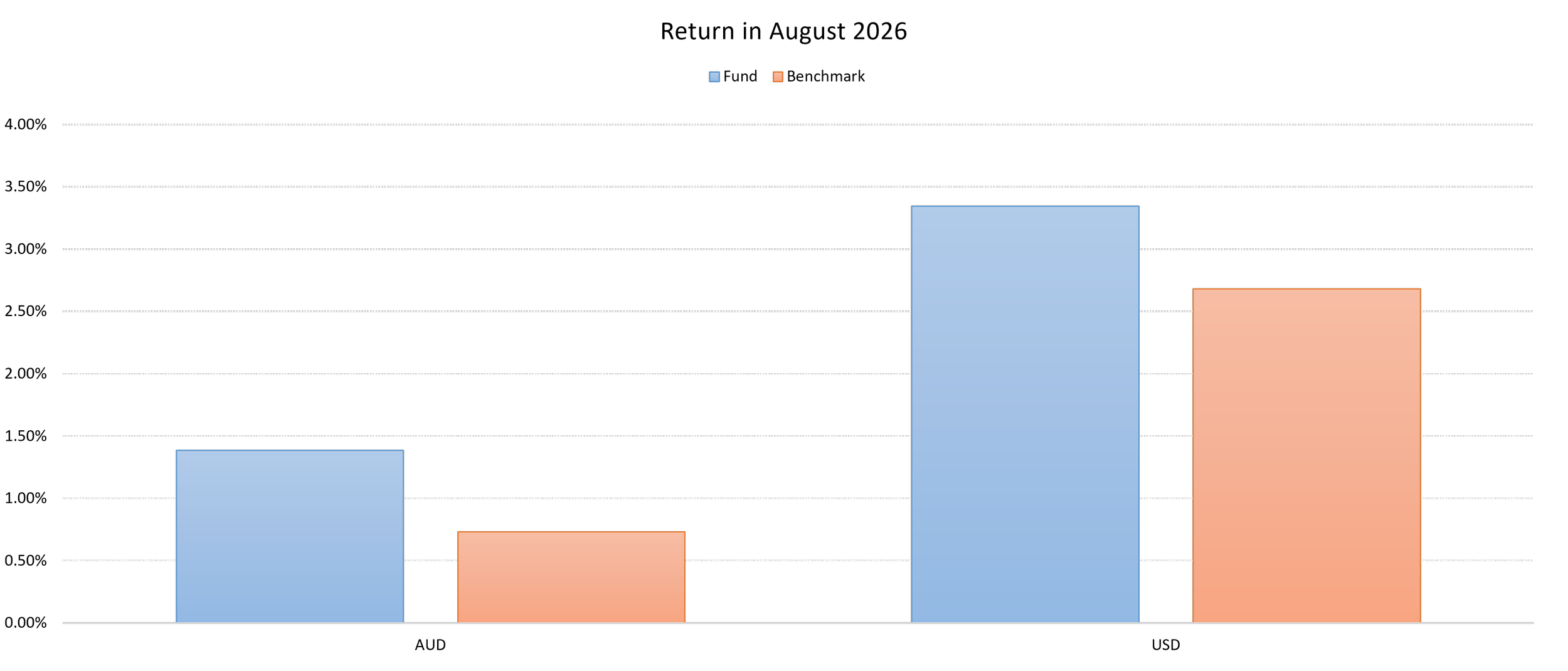
Performance in August (net of fees)

Performance over time in AUD terms (net of fees)
What happened in August?
August brought a recovery in US equities, as enthusiasm for artificial intelligence and corporate earnings outweighed concerns about inflation, interest rates and geopolitical risk. The S&P 500 gained 2.6%, the Nasdaq Composite rose 3.9%, and the Dow Jones Industrial Average advanced 1.3%. These are US-dollar price returns, excluding dividends. By month-end, the S&P 500 was approximately 12.3% above its starting point for the year. However, the positive monthly result concealed a less comfortable backdrop: share prices remained sensitive to bond yields, while economic data offered conflicting signals.
Technology regained momentum following July’s weakness, with investors continuing to reward businesses benefiting from AI investment. Participation extended beyond the largest technology companies: the S&P 500 Equal Weight Index returned approximately 2.1%, including dividends, while energy and materials also performed strongly. Nevertheless, smaller companies lagged, with the Russell 2000 returning around 1%. Software was another area of strength, outperforming semiconductors as investors assessed which businesses could translate AI adoption into higher revenues and productivity. The rally therefore reflected both renewed technology leadership and selective opportunities elsewhere.
Nvidia’s results illustrated the scale of the investment cycle. On 26 August, the company reported quarterly revenue of US$96.2 billion, up 106% from a year earlier, including US$89 billion from its data-centre business. Those figures demonstrated that spending on AI infrastructure continued to generate substantial commercial activity. For investors, the longer-term question remained how those benefits would be shared among chipmakers, cloud providers, software businesses and their customers. Strong industry growth can support earnings, but the price paid for that growth remains central to investment returns.
The economic releases were more mixed. The employment report published on 7 August initially showed that US payrolls had declined by 23,000 in July, while unemployment stood at 4.1%. Labour-force participation was 61.4%, having fallen by 0.7 percentage points since January. Together, these figures suggested limited momentum in employment despite a relatively low unemployment rate. Consumer spending also looked subdued: the July spending report released during August showed nominal expenditure increasing by 0.2%, with spending essentially unchanged after inflation. This complicated assessments of how much underlying strength remained in household demand.
Inflation provided some encouragement, although the different measures told different stories. July’s consumer price index, released on 12 August, rose just 0.1% over the month, bringing annual headline inflation to 3.4%. Core CPI, excluding food and energy, increased 0.2% monthly and 2.5% annually. However, the personal consumption expenditures figures released later in August showed annual headline inflation of 3.7% and core inflation of 3.3%, as reported at the time. The Federal Reserve’s preferred inflation measure therefore remained materially above its 2% objective.
Federal Reserve Chair Kevin Warsh’s Jackson Hole speech on 28 August reinforced the importance of that inflation challenge. Warsh described the economy as resilient and argued that broad financial conditions were not restrictive. He reaffirmed the Fed’s inflation target and indicated that policy action could be necessary without convincing progress towards it. Markets interpreted the remarks as raising the prospect of a rate increase: the implied probability of a September hike rose from approximately 35% before the speech to nearly 58% afterwards. Monetary policy remained an unresolved risk as August ended.
Bond markets supplied a further reminder of the cost of capital. The ten-year Treasury yield finished August near 4.75%, maintaining pressure on financing costs and equity valuations. During the month, Treasury Secretary Scott Bessent announced an expansion of purchases under the Treasury’s long-term bond-buyback programme. This briefly eased yields, but concerns about inflation, borrowing requirements and fiscal sustainability persisted. Higher government-bond yields also increased the competition facing equities for investors’ capital, making the durability of corporate earnings particularly important.
Geopolitics continued to influence commodities and market sentiment. Renewed US–Iran hostilities near month-end pushed Brent crude back above US$90 a barrel, highlighting the vulnerability of energy supplies and shipping routes. WTI crude gained approximately 2% over August, while gold futures rose around 9.6%. The US Dollar Index declined approximately 0.5%. These movements mattered beyond commodity portfolios: sustained energy costs could squeeze household purchasing power and corporate margins, while dollar movements affected the returns received by investors holding US assets in other currencies.
August’s combination of rising equities, strong AI demand and persistent inflation left investors balancing credible earnings opportunities against demanding financial conditions. In our assessment, the month reinforced the value of examining businesses individually: their cash generation, balance-sheet strength, pricing power and exposure to refinancing costs. Sustaining the market’s advance would require companies to deliver against earnings expectations while the economy absorbed elevated borrowing costs. That placed particular importance on valuation discipline and on distinguishing durable improvements in profitability from expectations already reflected in share prices.