Otso Monthly - November 2025
November was an interesting, and volatile, month. It was marked by caution over big-tech and AI names, Michael Burry (of Big Short fame) closing Scion Asset Management, and caution surrounding potential Federal Reserve moves amid a shut-down-induced data dessert.
How we performed
We delivered positive – but low returns in November. Disappointingly, we marginally underperformed the benchmark. In November, in AUD terms we delivered returns of 0.38% after fees (vs benchmark of 0.47%); in USD terms we delivered returns of 0.11% after fees (vs benchmark of 0.19%). We attribute some of the modest performance to reducing our exposure towards the end of November (which caused us to miss some gains in the final days).

Return in November, net of fees
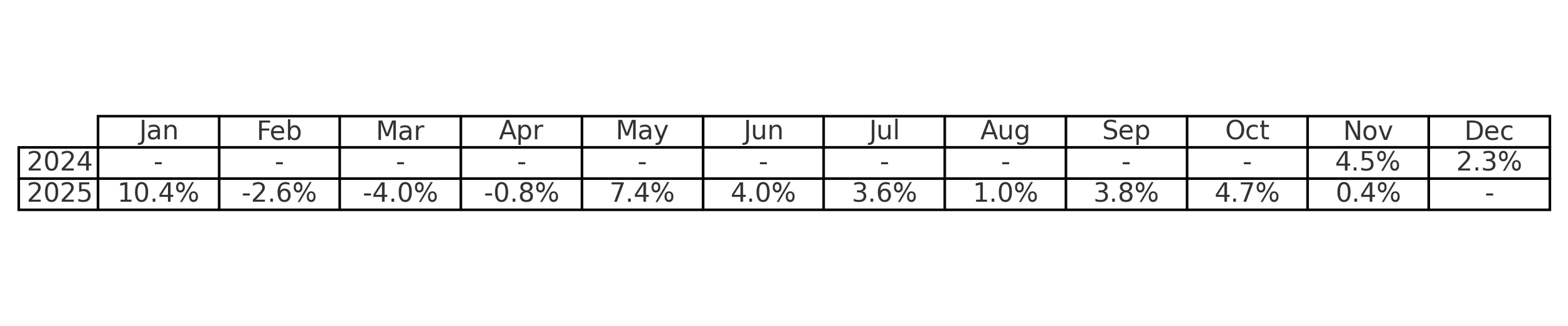
Returns over time, net of fees, in AUD terms
What moved markets
US equities delivered a volatile but ultimately resilient performance in November 2025. The core indices were flat-to-modestly-positive. The S&P 500 rose about 0.13% in November, with SPY increasing around 0.19% (in USD terms). The AUD modestly declined, resulting in slightly stronger performance in AUD terms. The Nasdaq Composite declined, largely due to big tech stocks.
Market themes aside, one of the most interesting events in November was Michael Burry closing Scion Asset Management. This may have been in the wake of some bearish bets on big tech. However, Scion’s 13F filings only give us an incomplete snapshot of what was in Scion’s portfolio at one point in time. However, we do not share Michael Burry’s extreme bearishness.
We saw several key themes in November.
• Late-cycle feel with resilient growth: Earnings and economic activity remain sufficiently strong to support equities, but progress on disinflation has slowed around 3%, and policy is transitioning into an easing phase from a still-restrictive level.
• From narrow to broader leadership: While 2025’s rally has been led by AI-linked mega-caps, November saw better breadth, with mid-caps, equal-weight indices, healthcare and other defensive/value sectors outperforming even as the headline S&P finished roughly flat.
• Valuation and concentration risk in focus: Multiple warnings—from central-bank research to independent strategists—highlight that US equities, particularly large-cap tech, now embed optimistic assumptions about growth and profitability. Rotation into more reasonably priced sectors and geographies is gaining traction. Michael Burry – whose opinion is always important but not always correct – voiced increasingly loud concerns over valuations.
• Policy and data uncertainty remain elevated: The shutdown-induced data gaps, coupled with an approaching Fed meeting, keep the near-term policy path uncertain. Markets are pricing a December cut but remain sensitive to any surprise on inflation or labour-market data once normal publication resumes.
Monetary policy, rates and the data vacuum
Monetary policy expectations remained the central macro driver. Markets spent much of November debating the likelihood and depth of a Federal Reserve easing cycle, with futures increasingly pricing a 25 bp cut at the December meeting and a relatively shallow path of additional cuts through 2026. Bond investors have shifted positioning toward the “belly” of the curve, reflecting a view that long-term yields may remain structurally higher around a 3% neutral rate.
Complicating the policy outlook was an unusual data vacuum. The extended US government shutdown forced the Bureau of Labor Statistics to cancel the release of the October CPI and the October employment report, and to delay the November CPI release into December. However, data has suggested disinflation progress.
Markets leaned more heavily on alternative gauges during November. The Fed’s preferred inflation measure, core PCE, was last reported at 2.8% year-on-year for September—still above the 2% target but much improved from earlier peaks—while nowcasting models from the Cleveland Fed suggested month-on-month CPI and PCE inflation in October and November remained in the 0.2–0.3% range, broadly consistent with a 3% annualised rate.
Growth, earnings and consumer signals
The macro backdrop remained broadly supportive for risk assets. Q3 earnings season concluded with a strong set of results: roughly 80-plus percent of S&P 500 companies beat consensus estimates, with aggregate EPS growth in the low-teens year-on-year and technology companies delivering particularly strong profit growth.
At the same time, there were signs of strain at the household level. The New York Fed’s November Survey of Consumer Expectations showed that US households had become more pessimistic about their personal financial situations and medical costs, even as their inflation expectations remained broadly stable (around 3.2% at the one-year horizon and 3% longer term) and perceptions of the job market actually improved.
Valuations, AI, and sector rotation
Valuation concerns persisted throughout November. The concerns partly related to the valuation per se of the Magnificent Seven and of big tech stocks. Deeper concerns related to the circular nature of some of the firms’ earnings, raising fears of potential contagion in a downturn. Cynics also implied that the apparently circular nature of the firms’ earnings was to create the appearance of earnings rather than merely due to the concentrated nature of the sector, implying potentially nefarious business operations.
These concerns manifested in notable sector rotation during November. Technology underperformed sharply. The S&P 500 information technology declined by more than 4% on the month. By contrast, defensive and value-oriented sectors, particularly healthcare, outperformed as investors sought earnings stability at more reasonable valuations.
Geopolitics, commodities and cross-asset signals
Geopolitical developments provided a mixed backdrop. On balance, geopolitical moves were modestly supportive for risk assets. Progress toward a US-China trade truce and ongoing efforts to broker a peace framework in the Russia-Ukraine conflict contributed to swings in energy prices and risk sentiment. Hopes of an eventual easing of sanctions on Russian exports helped push oil prices lower at times, which in turn supported consumer-facing sectors and weighed on energy equities.
At the same time, gold remained near record highs around $4,200/oz as both central banks and retail investors sought a hedge against lingering inflation and fiscal concerns. The unusual combination of elevated gold and buoyant equities underscores the degree of speculative activity in parts of the market and reinforces the case for disciplined risk management.
Going forward
We have a generally constructive view on US stocks. This is especially given our use of derivative overlays. However, we believe that a measured stance appears warranted: maintaining core exposure to US equities, but with an emphasis on quality balance sheets, diversified sector allocation beyond mega-cap tech. We do not invest directly in fixed income. However, we pay attention to moves in yields. We anticipate the Fed to cut rates. However, the market’s reaction will turn more on commentary surrounding the rate decision.
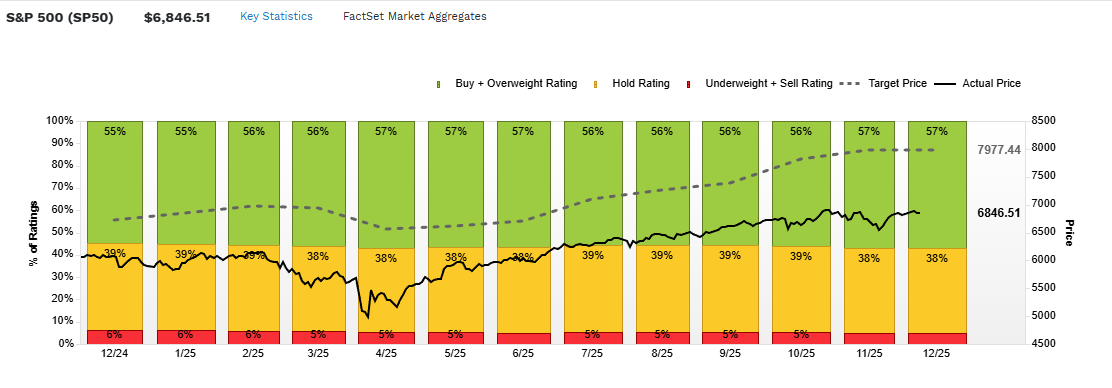
The S&P500 analyst consensus remains strong. However, as was clear from November, this does not necessarily translate into strong returns each month. In the early part of December, we see risk in relation to the Fed’s interest rate commentary. Thus, we will adopt a constructive but cautious position in the lead up to the rate decision.