How we performed?
Otso’s US fund performed well in October 2026, materially outperforming the market. In part, this reflected our then relatively lower exposure to technology companies, which we had down weighted in the wake of the September rate hike. This is despite the fact that we remain generally constructive on US markets, including tech (when correctly selected).
Net of fees, Otso’s US fund delivered 0.36% in AUD terms (vs benchmark of -1.79%) and 1.27% in USD terms (vs benchmark of -0.91%). The appreciation of the AUD during October weighed on the AUD denominated returns.
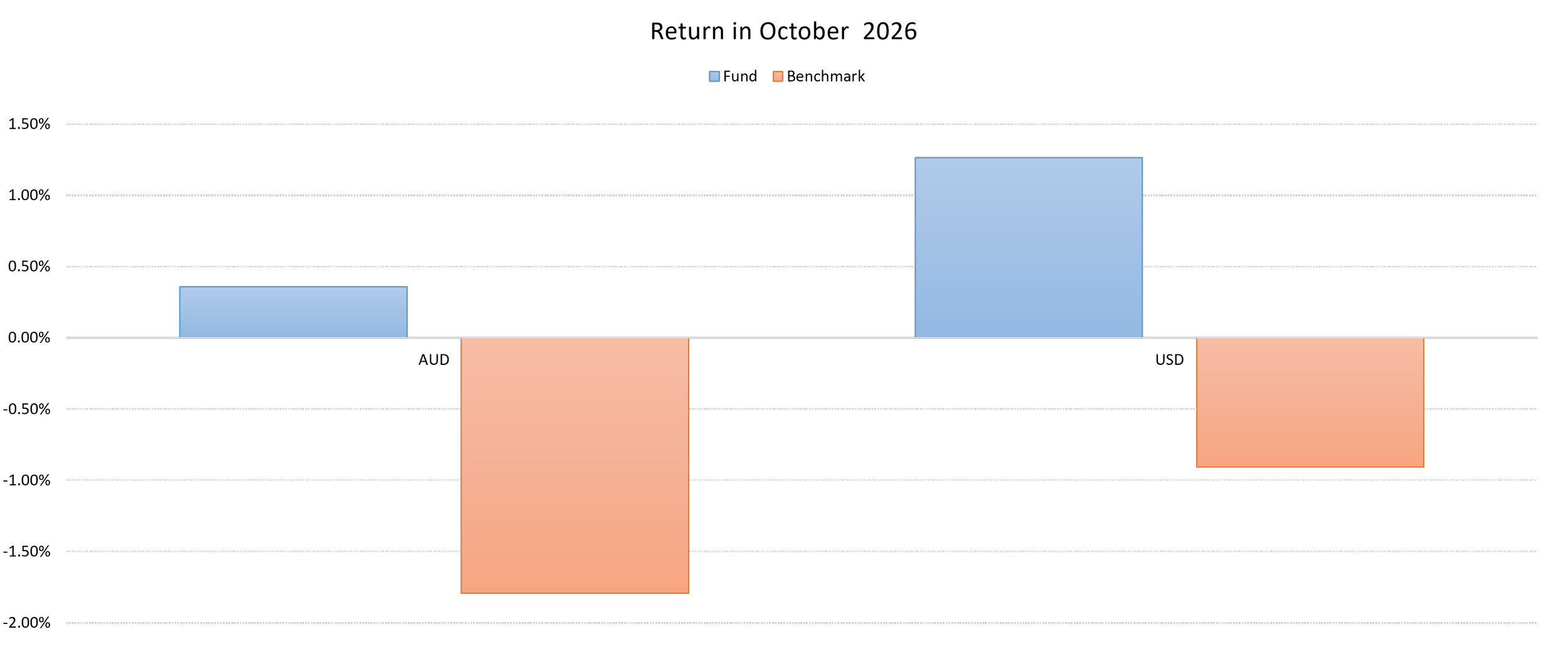
Performance in October 2026, net of fees
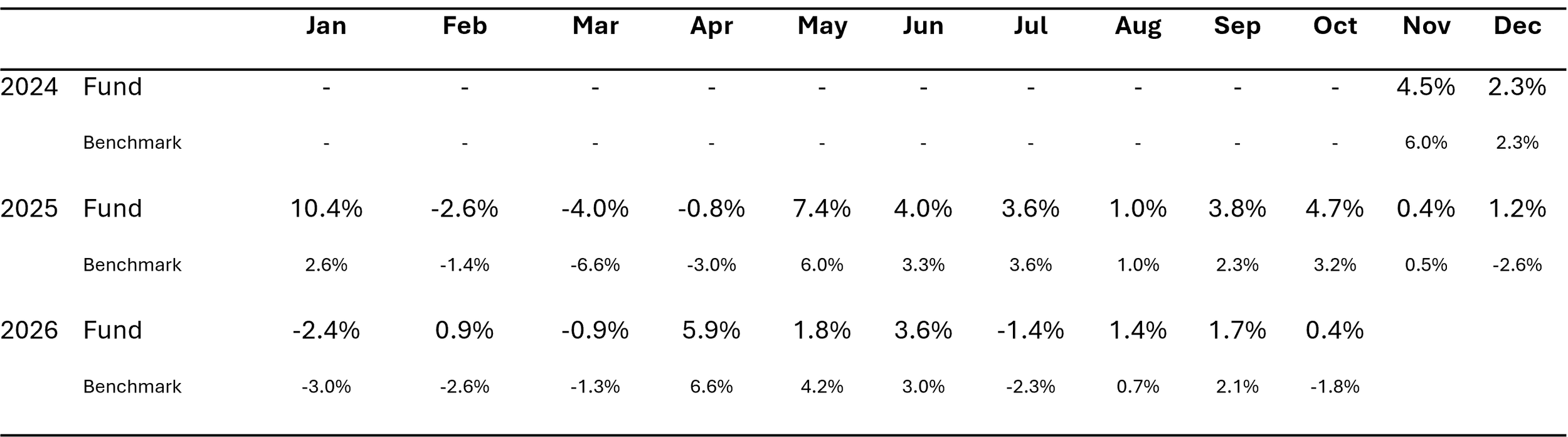
Historical performance in AUD terms, net of fees
What happened in markets?
October brought a sharp change in leadership across U.S. financial markets. Large technology stocks retreated as investors questioned the cost and prospective returns of artificial intelligence investment, while many defensive and value-oriented shares advanced. The S&P 500 fell 0.9% and the Nasdaq Composite lost 5.3%, compared with gains of 1.7% for the Dow Jones Industrial Average and 0.5% for the Russell 2000, measured by price returns. Despite October’s weakness, the S&P 500 remained up 10.7% for the year.
The headline indexes concealed considerable strength elsewhere. The equal-weight S&P 500 gained approximately 5%, and nine of the index’s 11 sectors advanced. Energy led with a 14.0% gain, followed by consumer staples at 11.6% and utilities at 10.2%. In contrast, information technology fell 6.8% and communication services dropped 15.1%. Large-cap value stocks outperformed growth stocks by 10.5 percentage points. This divergence highlighted how weakness in a handful of heavily weighted companies can obscure gains across much of the market. Market breadth also improved: 61% of S&P 500 constituents finished October above their 50-day moving average, compared with just 21% at the end of September.
Earnings announcements intensified scrutiny of the AI investment cycle. Results from Alphabet and Amazon raised concerns about the financing requirements and financial returns associated with enormous data center budgets. Intel plunged 28.6% on October 30 following its quarterly report, contributing to a broader semiconductor selloff. That day, the Nasdaq fell 2.9% and the S&P 500 declined 1.8%. The market reaction suggested that investors increasingly wanted evidence of profitable execution and cash generation to justify expectations for continued AI growth.
Broader corporate earnings nevertheless remained strong. By October 30, approximately 60% of S&P 500 companies had reported, with 82% beating earnings estimates. FactSet’s blended third-quarter earnings growth rate, combining reported results with estimates for companies yet to report, stood at 30.2%. However, aggregate earnings exceeded expectations by only 1.9%, well below the five-year average of 7.5%. Strong annual profit growth therefore coexisted with relatively modest positive surprises, helping explain why apparently healthy results did not consistently translate into rising share prices. The index’s forward price-to-earnings ratio eased to 18.7 times, below its five-year average of 19.8, although that aggregate measure masked substantial differences between individual companies and sectors.
Economic releases presented a similarly mixed picture. The advance GDP estimate showed third-quarter growth accelerating to a 3.4% annualized rate from 2.2% in the second quarter. Consumer spending and business investment remained supportive, with real final sales to private domestic purchasers rising at a 4.9% annualized rate. Hiring was considerably softer: the September employment report, released in October, showed payroll growth of just 29,000 and unemployment of 4.2%. Earlier payroll estimates were also revised lower, underscoring the contrast between resilient output and limited job creation.
Inflation continued to complicate the policy outlook. September’s consumer price index, released October 14, rose 0.6% during the month and 3.7% over the preceding year. Gasoline prices jumped 9.1%, accounting for more than half of the monthly headline increase. Core inflation, excluding food and energy, was more restrained at 2.6% annually, although its monthly increase of 0.3% still indicated persistent price pressures. The gap between headline and core inflation emphasized the influence of higher energy costs on household purchasing power.
Against that backdrop, the Federal Reserve held its target interest rate range at 3.75% to 4.00% on October 28. The decision passed 10 to two, with both dissenters favoring a quarter-point increase. The Fed described economic activity as expanding strongly and inflation as elevated. The split vote indicated that further tightening remained a live policy consideration. For investors, the combination of resilient spending, weak hiring, and energy inflation left the future direction of interest rates dependent on incoming data.
Treasuries rallied even as inflation remained a concern. The 10-year yield declined from approximately 5.29% at September’s close to around 4.93% at October’s end. Demand for government bonds strengthened amid anxiety about AI-related equities and the broader growth outlook. Falling yields provided relief after September’s bond selloff, although long-term borrowing costs remained elevated. The dollar index edged approximately 0.4% higher over the month.
Energy markets added another source of uncertainty. Brent crude gained 13.6% to finish near $118 per barrel as conflict involving Iran and risks around the Strait of Hormuz sustained supply concerns. Gold fell approximately 7%, while bitcoin declined 7.4%. Cryptocurrency markets also faced a major security shock: TRM Labs reported that approximately $6.36 billion was stolen from Binance on October 29, highlighting the operational risks accompanying digital asset exposure.
At month-end, attention turned toward November’s midterm elections, additional earnings announcements, and the next employment report. October’s divergence suggested that the durability of corporate cash flows, exposure to energy costs, and dependence on continued AI investment would remain important distinctions between market winners and laggards.